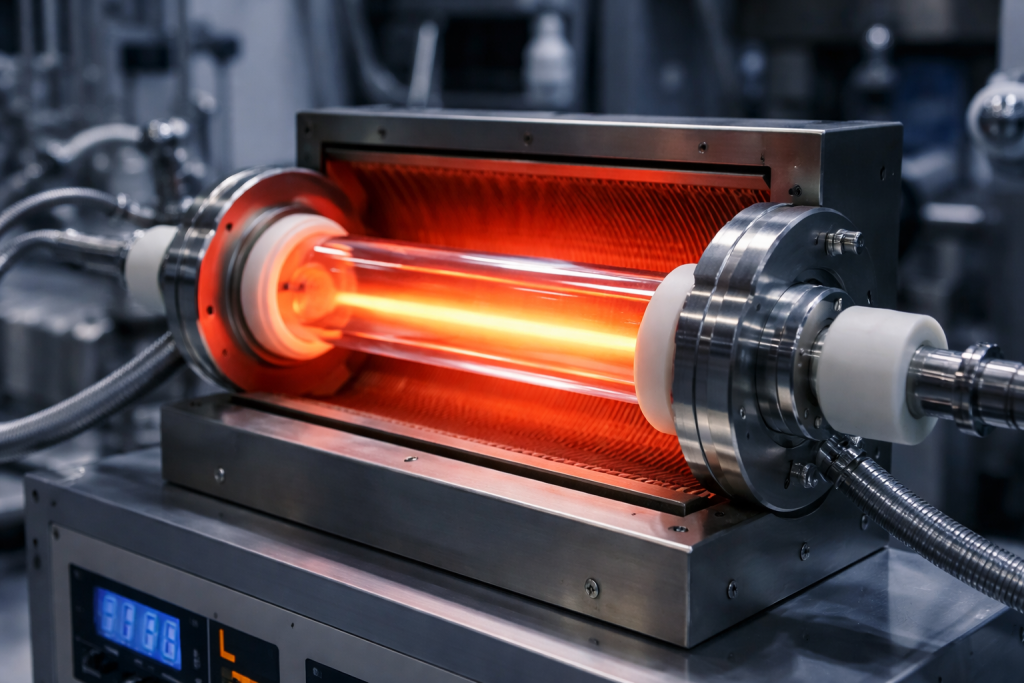
In modern chemical processing industries, material reliability is not just about mechanical strength—it is about chemical stability, thermal resistance, and long-term dimensional integrity under harsh environments. Among high-performance materials, fused quartz (fused silica) stands out as one of the most reliable solutions for corrosive and high-temperature applications.
Custom quartz flanges and quartz blocks are widely used in semiconductor wet benches, chemical reactors, laboratory systems, and high-purity process equipment where contamination and corrosion must be strictly controlled.

1. Why Quartz Is Ideal for Chemical Processing
Fused quartz is composed of ultra-pure SiO₂, offering a unique combination of properties that make it highly suitable for aggressive chemical environments.
Key properties:
- Extremely high chemical purity (low contamination risk)
- Excellent corrosion resistance (except HF acid)
- High thermal stability (up to ~1100°C continuous use)
- Very low thermal expansion
- Strong resistance to thermal shock
- High optical transparency (optional benefit in process monitoring)
From an engineering perspective, quartz behaves as a chemically inert structural material, making it ideal for high-purity systems.
2. What Are Quartz Flanges and Quartz Blocks?
Kvartsi laipat
Quartz flanges are precision-machined connecting components used to join pipes, chambers, or reaction systems.
Typical functions:
- Sealing chemical pipelines
- Connecting vacuum or pressure systems
- Supporting reactor interfaces
- Enabling modular system assembly
They are often used in environments requiring clean sealing without metal contamination.
Quartz Blocks
Quartz blocks are solid machined components used as:
- Reactor bases
- Support platforms
- Insulating spacers
- Custom structural holders in chemical systems
They provide both mechanical support and chemical resistance in aggressive processing environments.
3. Key Advantages in Corrosive Environments
1. Exceptional Chemical Resistance
Quartz resists most acids and chemicals, including:
- Hydrochloric acid (HCl)
- Nitric acid (HNO₃)
- Sulfuric acid (H₂SO₄)
- Organic solvents
Exception: Hydrofluoric acid (HF) can etch quartz rapidly.
2. High-Temperature Stability
Quartz maintains structural stability in high-temperature environments, making it suitable for:
- Thermal oxidation processes
- Chemical vapor deposition (CVD)
- Diffuusiouunijärjestelmät
3. Ultra-Low Contamination Risk
In industries such as semiconductors and fine chemicals, even trace metal contamination can affect product yield. Quartz offers:
- Extremely low metal ion leaching
- High-purity processing compatibility
- Cleanroom-grade stability
4. Thermal Shock Resistance
Quartz can withstand rapid temperature changes without cracking, which is critical in:
- Batch chemical reactors
- Rapid heating/cooling systems
4. Applications in Chemical and Industrial Systems
Custom quartz components are widely used in:
- Wet chemical processing equipment
- Semiconductor wafer cleaning systems
- Photovoltaic manufacturing lines
- High-purity laboratory reactors
- Vacuum chemical reaction chambers
- Acid/alkali resistant piping systems
In semiconductor wet benches, quartz is often the core structural material for chemical stability and purity control.
5. Quartz vs Other Engineering Materials
| Materiaali | Kemiallinen kestävyys | Temperature Stability | Contamination Risk | Kustannukset |
|---|---|---|---|---|
| Quartz (Fused Silica) | Excellent (except HF) | Erittäin korkea | Erittäin alhainen | Medium |
| Ruostumaton teräs | Kohtalainen | Korkea | Medium (metal ions) | Matala |
| Alumina Ceramic | Korkea | Erittäin korkea | Matala | Medium-High |
| PTFE | Excellent (chemicals) | Low (~260°C max) | Matala | Matala |
Quartz provides the best balance for high-purity + high-temperature + corrosion resistance systems.
6. Custom Manufacturing Capabilities
Custom quartz flanges and blocks can be engineered based on system requirements:
Available customization options:
- Dimensions and tolerances (precision CNC machining)
- Surface finish (polished or matte)
- Hole patterns and threading
- Sealing interface design
- Thermal resistance optimization
- High-purity grade selection (JGS1/JGS2 equivalents)
For B2B industrial applications, customization is critical to ensure system compatibility and sealing performance.
7. Key Design Considerations
When designing quartz components for chemical systems, engineers must consider:
- Thermal expansion matching with connected materials
- Stress concentration around flange edges
- Seal compatibility (O-rings, metal seals, or quartz-to-quartz sealing)
- Flow dynamics in chemical channels
- Resistance to thermal cycling fatigue
Poor design can lead to micro-cracks, leakage, or premature failure.
8. Industry Trend: High-Purity Chemical Systems
Demand for quartz components is increasing due to:
- Expansion of semiconductor manufacturing
- Growth of photovoltaic industry
- Increased requirement for ultra-clean chemical processes
- Shift toward high-purity wet processing systems
Quartz is becoming a standard structural material in next-generation chemical equipment, replacing traditional metal-based systems in high-purity environments.
9. Päätelmät
Custom quartz flanges and blocks play a critical role in modern chemical processing systems where corrosion resistance, purity, and thermal stability are essential.
- Quartz flanges ensure clean and reliable system connections
- Quartz blocks provide stable structural support in harsh environments
- Together, they enable high-performance chemical processing with minimal contamination risk
For industries operating in extreme chemical and thermal conditions, quartz remains one of the most reliable engineering materials available today.