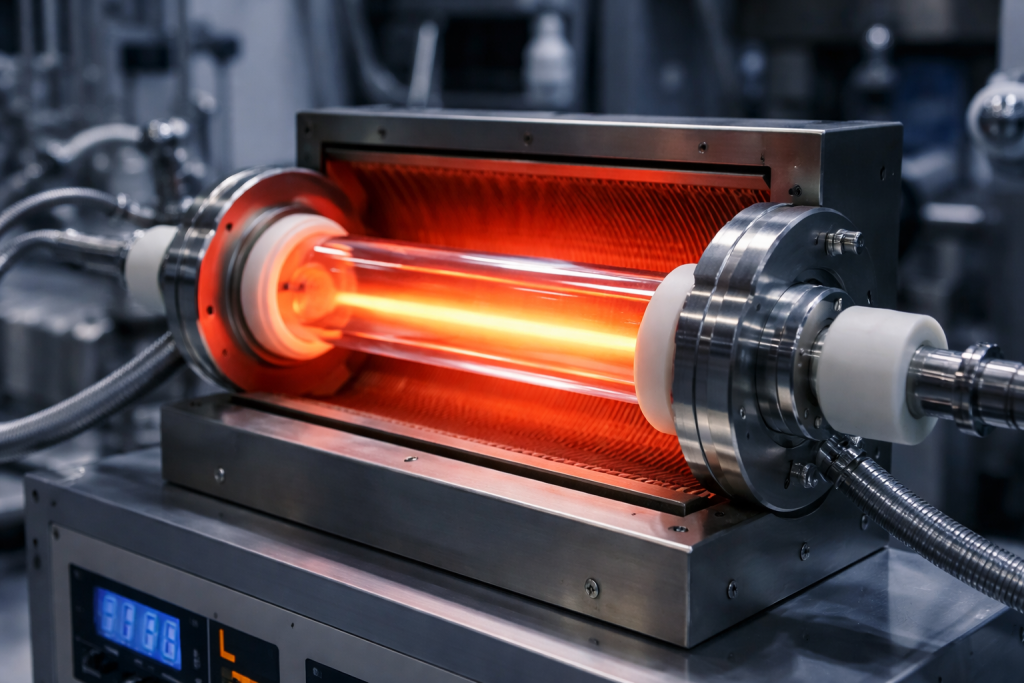
Semiconductor manufacturing environments demand extreme precision, ultra-clean processing conditions, and stable thermal performance. Inside diffusion and oxidation systems, semiconductor furnaces operate at temperatures exceeding 1000°C while maintaining strict contamination control standards.
To achieve these requirements, high-purity quartz components play a central role. Quartz parts are not simply supporting accessories—they directly influence process stability, wafer quality, particle generation, and equipment lifetime.
Understanding the functions of semiconductor quartz components helps engineers optimize process performance and select suitable materials for critical applications.
Why Quartz Is Used in Semiconductor Furnaces
Fused quartz (high-purity SiO₂) is widely used because it combines several properties that are difficult to achieve with conventional materials.
Key advantages include:
- Excellent high-temperature resistance
- Erittäin alhainen lämpölaajeneminen
- Korkea kemiallinen puhtaus
- Resistance to acids and process chemicals
- Vähäinen hiukkasten muodostuminen
- Strong thermal shock resistance
- Stable performance during repeated thermal cycling
Quartz remains dimensionally stable even during long operating periods under aggressive thermal conditions.
These characteristics make it ideal for semiconductor diffusion and oxidation processes.
Typical Operating Conditions in Semiconductor Furnaces
Semiconductor furnaces are used in multiple high-temperature processes including:
- Thermal oxidation
- Diffusion
- LPCVD deposition
- Annealing
- Dopant drive-in
- Silicon nitride processing
Typical operating conditions:
| Parametri | Typical Range |
|---|---|
| Temperature | 800–1200°C |
| Process Atmosphere | Oxygen, Nitrogen, Hydrogen |
| Cleanliness Requirement | Extremely high |
| Particle Tolerance | Erittäin alhainen |
| Thermal Cycling | Frequent |
Under these conditions, furnace materials must maintain structural integrity and ultra-low contamination characteristics.
Critical Quartz Components Inside Semiconductor Furnaces
Quartz Furnace Tube
The furnace tube is one of the largest and most important quartz components.
Its primary function is to create an isolated process chamber around wafers and maintain a controlled thermal environment.
Functions:
- Contains process gases
- Provides thermal insulation
- Maintains clean processing conditions
- Supports temperature uniformity
The tube operates continuously under high temperatures and repeated heating cycles.
Any deformation or contamination can affect process consistency.
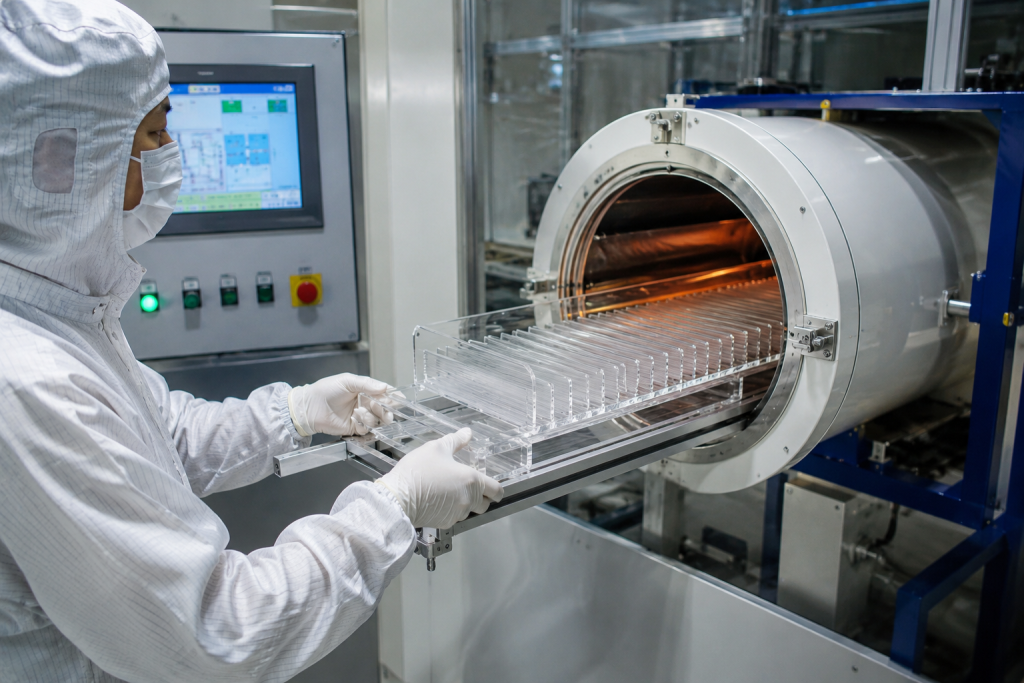
Quartz Wafer Boat
Quartz wafer boats hold silicon wafers during thermal processing.
They are designed with slots to support multiple wafers at precise spacing.
Functions:
- Secure wafer positioning
- Maintain equal spacing
- Ensure gas flow uniformity
- Reduce wafer contact area
Proper boat design directly affects:
- Temperature distribution
- Process repeatability
- Yield performance
For larger wafers and advanced nodes, tighter dimensional tolerances become increasingly important.
Quartz Paddle
The quartz paddle acts as a transfer mechanism that moves wafer boats into and out of furnace tubes.
Functions:
- Supports wafer loading
- Maintains alignment
- Minimizes vibration
- Provides stable transport
Because paddles experience repetitive motion and thermal exposure, dimensional stability is critical.
Poorly manufactured paddles may cause:
- Wafer shifting
- Particle generation
- Mechanical stress
Quartz End Caps
End caps seal furnace openings and help maintain controlled process conditions.
Functions:
- Isolate process chambers
- Support gas sealing
- Maintain furnace atmosphere
- Reduce contamination intrusion
Precision machining is essential to ensure proper sealing performance.
Quartz Gas Injector Tubes
Gas injectors distribute process gases uniformly throughout the furnace.
Functions:
- Deliver process gases
- Improve gas flow consistency
- Maintain concentration uniformity
- Enhance process repeatability
Improper gas distribution may result in:
- Uneven oxidation
- Film thickness variation
- Process instability
Injector geometry is often customized for specific furnace designs.
Quartz Liners
Quartz liners provide additional protection inside furnace chambers.
Functions:
- Shield furnace components
- Minimize contamination
- Improve maintenance efficiency
- Extend equipment lifetime
Replacing liners is often more economical than replacing larger furnace assemblies.
Kvartsi ikkunat
Some furnace systems include quartz viewing windows.
These optical components allow engineers to monitor internal conditions without disrupting the process environment.
Functions:
- Visual process observation
- Optical monitoring
- Sensor transmission
- High-temperature viewing
High optical clarity and thermal resistance are essential.
Why High Purity Matters
Not all quartz materials are suitable for semiconductor use.
Even trace metallic contamination can migrate at elevated temperatures and affect wafer quality.
Typical impurity control targets include:
| Contaminant | Typical Requirement |
|---|---|
| Aluminum (Al) | <1 ppm |
| Iron (Fe) | <1 ppm |
| Sodium (Na) | <1 ppm |
| Potassium (K) | <1 ppm |
Excessive contamination may lead to:
- Yield loss
- Particle defects
- Electrical instability
- Device reliability issues
As process nodes continue shrinking, contamination requirements become even stricter.
Challenges Faced by Quartz Components
Semiconductor furnace environments place severe demands on quartz materials.
Common challenges include:
Devitrification
Extended exposure to high temperatures can gradually transform quartz into crystalline structures.
Possible effects:
- Reduced transparency
- Increased brittleness
- Particle generation
Thermal Stress
Rapid heating and cooling cycles create internal stress.
Poor thermal design may cause:
- Cracks
- Surface defects
- Mechanical failure
Chemical Attack
Aggressive process chemistries may gradually degrade quartz surfaces.
Surface erosion increases contamination risk.
Regular inspection and replacement schedules are important.
Selecting Semiconductor Quartz Components
When selecting quartz components, engineers should consider:
- Material purity
- Dimensional tolerance
- Surface quality
- Thermal stability
- Manufacturing capability
- Semiconductor experience
- Custom processing support
High-quality quartz fabrication often includes:
- CNC-työstö
- Flame polishing
- Precision grinding
- Surface cleaning
- Particle control procedures
Lopulliset ajatukset
Semiconductor furnaces rely heavily on quartz components to maintain process stability and wafer quality. Furnace tubes, boats, paddles, gas injectors, and other quartz parts are not passive hardware—they directly affect contamination control, temperature uniformity, and production yield.
As semiconductor manufacturing continues toward smaller geometries and tighter process windows, demand for ultra-clean and precision-machined quartz components will continue to grow.
Selecting the right semiconductor quartz supplier is not simply a purchasing decision—it is an investment in long-term process performance.
FAQ
Why is quartz preferred over ordinary glass in semiconductor furnaces?
Quartz can withstand temperatures above 1000°C, has extremely low thermal expansion, and offers superior purity and contamination resistance.
How often should semiconductor quartz components be replaced?
Replacement frequency depends on operating temperature, process chemistry, and contamination levels. Regular inspection is recommended.
Can semiconductor quartz components be customized?
Yes. Quartz parts can be custom manufactured according to furnace models, wafer sizes, dimensional tolerances, and process requirements.