Singlemode optical fiber is the backbone of modern telecommunications and data transmission systems. While many engineers associate singlemode fiber with the standard 9/125 μm core/cladding structure, the performance characteristics vary significantly depending on the fiber standard. Among the most widely used are G.652.D, G.657.A1, and G.657.A2, each defined by the International Telecommunication Union (ITU-T).
This article provides a technical yet accessible comparison of these fiber types, with a particular focus on why G.657.A2 bend-insensitive fiber is becoming the preferred solution for high-density and constrained installations.
1. Fundamentals of Singlemode Fiber Standards
The ITU-T recommendations define optical fiber performance in terms of:
- Geometrical properties (core/cladding diameter)
- Transmission characteristics (attenuation, dispersion)
- Mechanical reliability
- Bending performance
All three fiber types—G.652.D, G.657.A1, and G.657.A2—share the same physical dimensions:
- Core diameter: ~9 μm
- Cladding diameter: 125 μm
This ensures full compatibility in splicing and connectorization, allowing them to be deployed interchangeably in most networks.
2. G.652.D: The Conventional Standard
G.652.D is the most widely deployed singlemode fiber standard and serves as the baseline for long-haul and metro networks.
Key Characteristics:
- Optimized for 1310 nm and 1550 nm transmission windows
- Low attenuation and dispersion
- Supports advanced technologies such as CWDM/DWDM
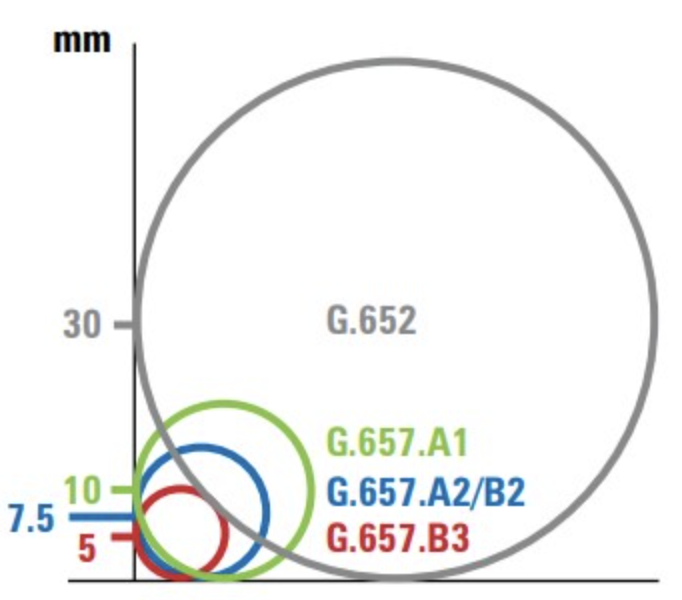
- Minimum bend radius: ~30 mm
Limitations:
While G.652.D performs excellently in transmission, it is sensitive to bending losses, making it less suitable for:
- Tight cable routing
- Data center patch panels
- High-density racks
3. G.657 Standard: Bend-Insensitive Fiber
To address installation challenges in modern networks, the ITU introduced G.657, specifically targeting bend-insensitive performance.
Classification:
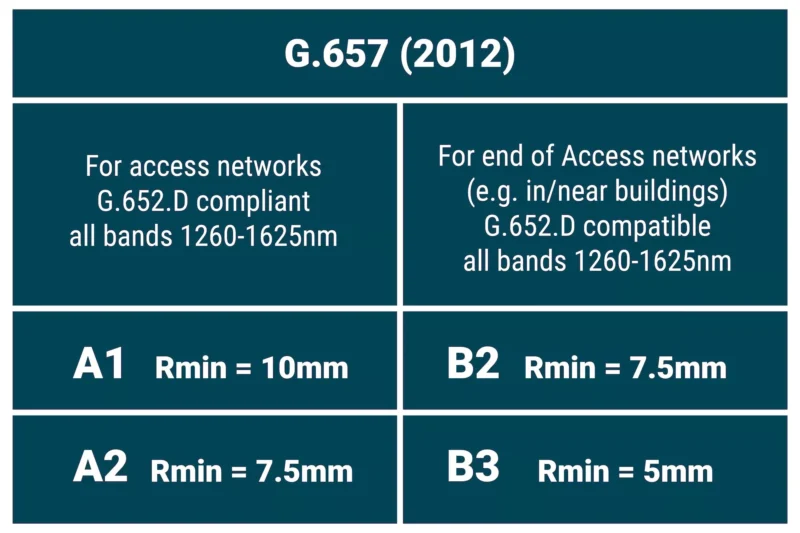
- Category A (G.657.A1, G.657.A2): Backward compatible with G.652.D
- Category B (G.657.B2, B3): Ultra-tight bending, but less compatibility
In practical deployments, Category A fibers dominate, especially A1 and A2.
4. G.657.A1 vs G.652.D
G.657.A1 improves upon G.652.D primarily in bending performance.
| Parámetro | G.652.D | G.657.A1 |
|---|---|---|
| Bend Radius | ~30 mm | ~10 mm |
| Compatibility | — | Fully compatible with G.652.D |
| Aplicación | Long-haul networks | Access networks, moderate density |
Insight:
G.657.A1 provides a 3× improvement in bending tolerance, significantly reducing signal loss in moderately constrained environments.
5. G.657.A2: Advanced Bend Insensitivity
G.657.A2 represents a further evolution, offering superior flexibility without sacrificing transmission performance.
| Parámetro | G.657.A1 | G.657.A2 |
|---|---|---|
| Minimum Bend Radius | 10 mm | 7.5 mm |
| Compatibility | G.652.D | G.652.D |
| Typical Use | Access networks | High-density, tight spaces |
Technical Advantages:
- Enhanced macro-bending loss resistance
- Stable performance even under tight routing conditions
- Ideal for short-radius cable management scenarios
6. Why G.657.A2 Is Preferred in Modern Networks
With the rapid growth of data centers, FTTH (Fiber-to-the-Home), and 5G infrastructure, installation environments are becoming increasingly compact.
Key Benefits of G.657.A2:
1. Ultra-Tight Bend Radius
A minimum bend radius of 7.5 mm allows routing in extremely confined spaces without significant signal degradation.
2. High Reliability in Dense Environments
Maintains low insertion loss even in:
- Patch panels
- Server racks
- Enclosures
3. Full Backward Compatibility
Seamlessly integrates with existing G.652.D infrastructure, enabling cost-effective upgrades.
4. Reduced Installation Risk
Less sensitivity to installer handling reduces:
- Micro-bending losses
- Long-term failure rates
7. Typical Applications
G.657.A2 bend-insensitive fiber is particularly suitable for:
- High-density data centers
- FTTx networks (especially indoor wiring)
- Telecommunications cabinets and closures
- Complex routing environments with multiple bends
8. Product Recommendation: G.657.A2 Bend Insensitive Single Mode Optical Fiber
For modern optical networks requiring both performance and flexibility, our G.657.A2 Bend Insensitive Single Mode Optical Fiber offers an optimal solution.
Key Features:
- Compliant with ITU-T G.657.A2 and G.652.D
- Minimum bend radius: 7.5 mm
- Low attenuation and insertion loss
- Optimized for 1310 / 1550 nm transmission
- Compatible with standard connectors (LC, SC, FC, APC/UPC)
Engineering Value:
By adopting G.657.A2 fiber, network designers can:
- Increase cable density without compromising performance
- Simplify installation in constrained architectures
- Improve long-term system stability
9. Conclusion
While G.652.D remains the industry standard for traditional deployments, G.657.A1 and G.657.A2 address the growing need for flexibility in modern network environments.
Among them, G.657.A2 stands out as the most versatile and future-proof option, combining:
- Tight bend tolerance
- Full compatibility
- High transmission performance
As network infrastructure continues to evolve toward higher density and complexity, G.657.A2 bend-insensitive fiber is no longer optional—it is becoming essential.