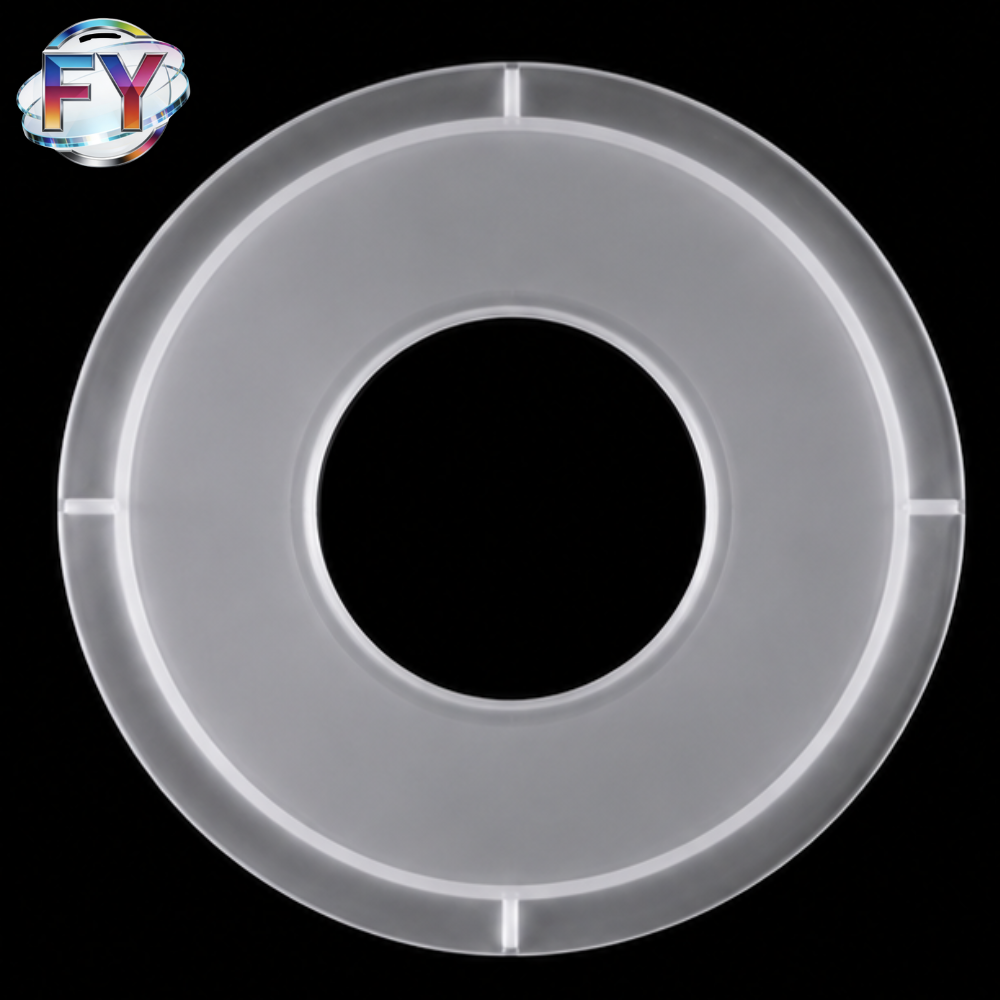
Custom quartz flanges are widely used in semiconductor processing equipment, laboratory reactors, vacuum systems, chemical handling assemblies and high-temperature furnace components. They may be welded to quartz tubes, connected to gas lines or used as sealing interfaces between quartz chambers and metal equipment.
Although a quartz flange may appear to be a relatively simple component, its performance depends on several closely related specifications. An incomplete drawing or an unsuitable tolerance can result in sealing failure, assembly difficulties, thermal stress or cracking during installation.
This guide explains the main information buyers and engineers should provide when ordering a custom quartz flange.
1. Define the Application First
Before determining the flange dimensions, the manufacturer should understand the intended operating conditions. These conditions influence the quartz grade, structural design, surface treatment and achievable tolerances.
Important application information includes:
- Semiconductor, photovoltaic, laboratory or industrial use
- Vacuum, atmospheric or pressurized operation
- Maximum and normal operating temperatures
- Heating and cooling rates
- Process gases or chemicals
- Required cleanliness level
- Whether the flange will be welded to a quartz tube
- Whether it will connect to quartz, metal or polymer components
- Expected service life and maintenance frequency
For semiconductor applications, it is also helpful to identify the specific process, such as diffusion, oxidation, CVD, etching, annealing or wet chemical processing.
2. Select the Appropriate Quartz Material
“Quartz” can refer to different grades of fused silica or fused quartz. The correct material should be selected according to purity, thermal performance, optical requirements and process environment.
Electric-Fused Quartz
Electric-fused quartz is manufactured by melting high-purity quartz raw material using electrical heating. It is commonly used for industrial, laboratory and semiconductor furnace components.
Typical characteristics include:
- Resistencia a altas temperaturas
- Baja dilatación térmica
- Good chemical stability
- Suitable mechanical strength
- Good cost-performance balance
Flame-Fused Quartz
Flame-fused quartz is produced by melting quartz material in a flame. Depending on the raw material and manufacturing process, it can provide good purity and transparency.
It is often selected for:
- Transparent quartz assemblies
- Laboratory equipment
- Chemical processing systems
- Optical observation components
Sílice fundida sintética
Synthetic fused silica is manufactured from high-purity chemical precursors rather than natural quartz crystal.
It may be required when the application needs:
- Extremely low metallic impurity levels
- Alta transmisión ultravioleta
- Controlled hydroxyl content
- High optical homogeneity
- Advanced semiconductor-process compatibility
The material specification should clearly state the required quartz grade or the performance requirements the material must meet. If a specific grade is not mandatory, provide the operating conditions so the manufacturer can recommend a suitable option.
3. Specify the Main Flange Dimensions
A complete quartz flange drawing should include all dimensions that affect installation, alignment and sealing.
Outside Diameter
The outside diameter determines the overall flange size and whether it fits the surrounding equipment. Sufficient material should remain between the inner opening, sealing groove and flange edge.
Inside Diameter
The inside diameter may correspond to:
- The process tube diameter
- The gas-flow opening
- The chamber opening
- A welded quartz tube
- An internal component clearance requirement
The drawing should clarify whether the dimension refers to the finished opening or the diameter before welding.
Flange Thickness
Thickness affects mechanical strength, heat distribution, bolt-hole stability and resistance to deformation.
A thicker flange may provide greater rigidity, but excessive thickness can increase weight and produce larger thermal gradients. The suitable thickness should therefore be based on the flange diameter, mounting method and operating temperature.
Tube Dimensions
If the flange will be welded to a quartz tube, specify:
- Tube outside diameter
- Tube inside diameter
- Wall thickness
- Tube length
- Concentricity requirement
- Weld position
- Required transition profile
Nominal tube size alone is usually insufficient for precision assemblies.
Step, Recess and Shoulder Dimensions
Some quartz flanges include a machined step or shoulder for alignment with another component. The drawing should identify:
- Step diameter
- Step depth or height
- Fit requirement
- Edge radius
- Reference surface
These features can improve concentricity and assembly repeatability, but overly tight fits should be avoided because quartz is brittle and does not tolerate forced assembly.
4. Define Dimensional Tolerances Carefully
Tighter tolerances generally require additional grinding, machining, polishing and inspection. Applying unnecessarily strict tolerances to every dimension can increase cost without improving performance.
A practical drawing separates dimensions into three groups:
| Dimension type | Typical importance |
|---|---|
| Critical sealing dimensions | Directly influence leakage and gasket compression |
| Assembly dimensions | Control alignment, clearance and mounting |
| Non-critical dimensions | Have limited influence on function |
Critical dimensions may include sealing-face flatness, groove depth, bolt-hole position and alignment with the connected tube.
The required tolerance should be based on the actual assembly rather than copied from a metal flange drawing. Quartz components cannot always be manufactured, handled or clamped in the same way as stainless-steel parts.
When requesting a quotation, identify which tolerances are mandatory and which can follow the manufacturer’s standard fabrication capability.
5. Specify Flatness, Parallelism and Perpendicularity
Geometric tolerances are particularly important for quartz flanges used as sealing or alignment surfaces.
Planitud
Flatness controls the variation across the sealing face. Poor flatness can cause uneven gasket compression, localized stress and vacuum leakage.
The required flatness depends on:
- Flange diameter
- Sealing material
- Vacuum level
- Tratamiento de superficies
- Mounting structure
A highly precise sealing surface may require mechanical grinding and polishing rather than flame polishing alone.
Paralelismo
Parallelism may be required between the front and rear flange faces or between the flange face and another reference surface. This is important when the flange is mounted between rigid components.
Perpendicularity
If a quartz tube is welded to the flange, perpendicularity between the tube axis and flange face affects alignment with the equipment.
Poor perpendicularity may force installers to pull the assembly into position using bolts or clamps. This can introduce mechanical stress and increase the risk of fracture.
6. Describe Bolt Holes and Mounting Features
Bolt-hole information should include:
- Number of holes
- Hole diameter
- Bolt-circle diameter
- Angular spacing
- Position tolerance
- Hole type
- Edge treatment
- Orientation relative to ports or other features
The drawing should clearly distinguish between through holes, blind holes and counterbored features.
Quartz should not normally be subjected to direct, highly concentrated bolt pressure. Mounting systems may require:
- Soft washers
- Polymer or elastomer pads
- Load-spreading plates
- Controlled bolt torque
- Spring-loaded fasteners
Adequate clearance around bolts helps prevent contact between the quartz and metal hardware during thermal expansion.
All hole edges should generally be rounded or chamfered to reduce stress concentration and chipping.
7. Design the Sealing Interface
The sealing method is one of the most important parts of a custom quartz flange specification.
Common sealing options include:
- Flat gasket sealing
- O-ring sealing
- Ground quartz joints
- Clamped vacuum connections
- Metal-to-quartz transition assemblies
- Permanently fused quartz connections
For an O-ring groove, specify:
- Groove inside and outside diameter
- Groove width
- Groove depth
- O-ring cross-section
- O-ring material
- Target compression
- Surface-finish requirement
The O-ring material must be compatible with the operating temperature, vacuum level and process chemicals. The groove design should also avoid excessive sealing force that could load the quartz unevenly.
For a flat gasket, define the gasket material, thickness, contact width and recommended compression range.
8. Specify Surface Finish and Edge Treatment
Different parts of a quartz flange may require different surface treatments.
As-Fabricated Surface
An as-fabricated surface may be acceptable for non-sealing areas where appearance and dimensional precision are not critical.
Ground Surface
Grinding can improve dimensional accuracy and flatness, but it may leave a matte appearance and microscopic surface damage. The grinding process should be controlled carefully for critical components.
Mechanically Polished Surface
Mechanical polishing can produce a smoother, more precise sealing face. It may be used where better flatness, reduced roughness or improved gasket contact is required.
Flame-Polished Surface
Flame polishing smooths surface irregularities and sharp edges by controlled heating. It is commonly used to improve appearance and reduce surface defects.
However, flame polishing can slightly change dimensions and is not always sufficient for a precision sealing face.
The drawing should also specify edge treatment, such as:
- Chamfered edges
- Rounded edges
- Fire-polished edges
- Defined edge radius
- Chip-free requirement
Sharp internal corners should be avoided whenever possible because they act as stress-concentration points.
9. Include Ports and Connection Details
Custom quartz flanges may contain one or more ports for gas delivery, exhaust, sensors, thermocouples, pressure measurement or liquid circulation.
For each port, specify:
- Port outside and inside diameter
- Wall thickness
- Port length
- Position from the flange center
- Installation angle
- Connection type
- Orientation
- Required welding geometry
If multiple ports are present, a two-dimensional drawing may not fully describe the orientation. A 3D model or clearly marked sectional views can reduce manufacturing errors.
The manufacturer should also know whether the ports will connect to:
- Flexible tubing
- Vacuum fittings
- Ground glass joints
- Metal transition fittings
- Additional quartz components
10. Consider Thermal Expansion and Mechanical Stress
Fused quartz has a very low coefficient of thermal expansion, which provides excellent thermal-shock resistance. However, a quartz flange can still crack when it is rigidly connected to materials that expand at different rates.
Potential risk factors include:
- Direct connection to a metal frame
- Uneven flange heating
- Excessive bolt torque
- Misaligned mounting holes
- Rapid localized cooling
- Rigid pipe connections
- Insufficient gasket flexibility
The assembly should allow limited movement as temperatures change. Flexible seals, suitable clearances and uniform clamping are often more important than simply increasing the flange thickness.
The manufacturer should be informed if one side of the flange will remain cool while the other side is exposed to high process temperatures.
11. Define Cleanliness and Inspection Requirements
Quartz flanges used in semiconductor and high-purity applications may require controlled cleaning and packaging.
Possible requirements include:
- Removal of particles and polishing residue
- Limpieza con ácido
- Deionized-water rinsing
- Controlled drying
- Embalaje para salas blancas
- Double-bag packaging
- Individual protective packing
- Non-contact protection for sealing surfaces
Inspection requirements may include:
- Dimensional inspection
- Flatness measurement
- Visual defect inspection
- Surface-quality inspection
- Leak testing
- Material certification
- Cleaning records
- Inspection reports
The acceptance criteria should define allowable scratches, chips, bubbles, inclusions, devitrification and surface contamination.
12. Information to Send to the Manufacturer
A complete request for quotation should contain the following information:
| Especificación | Information to provide |
|---|---|
| Aplicación | Equipment and process type |
| Material | Quartz grade or required purity |
| Dimensiones | OD, ID, thickness and feature sizes |
| Tolerances | Critical dimensional tolerances |
| Geometry | Flatness, parallelism and perpendicularity |
| Tube connection | Tube OD, ID, wall thickness and weld position |
| Bolt pattern | Hole diameter, quantity and bolt-circle diameter |
| Sealing design | O-ring groove, gasket or joint details |
| Ports | Size, position, angle and connection type |
| Acabado superficial | Ground, mechanically polished or flame-polished |
| Edge treatment | Chamfer, radius or fire polishing |
| Operating conditions | Temperature, vacuum, pressure and chemicals |
| Cleanliness | Cleaning and packaging requirements |
| Quantity | Cantidades de prototipos y de producción |
| Documentation | Inspection report or material certification |
Providing a PDF drawing together with a STEP file is usually helpful for components with complex geometry. The PDF drawing should remain the primary source for tolerances, surface requirements and inspection criteria.
Common Specification Mistakes
Several common mistakes can delay production or lead to unsuitable quartz components:
- Providing only the outside diameter and thickness
- Omitting the sealing method
- Applying metal-part tolerances directly to quartz
- Failing to identify critical dimensions
- Using sharp internal corners
- Omitting port orientation
- Ignoring differential thermal expansion
- Specifying excessive bolt force
- Failing to define surface treatment
- Not stating the required cleaning level
Discussing these details before production is significantly less expensive than modifying the equipment or remaking the quartz flange after delivery.
Preguntas frecuentes
Can a quartz flange be manufactured from a customer drawing?
Yes. Quartz flanges can be fabricated according to 2D drawings, 3D models or physical samples. A fully dimensioned drawing is preferred when sealing and alignment tolerances are important.
Can quartz flanges include bolt holes and O-ring grooves?
Yes. Bolt holes, grooves, recesses, steps and multiple ports can be machined into quartz flanges. Their dimensions must be designed with sufficient edge distance and suitable corner radii.
Can a quartz flange be welded directly to a quartz tube?
Yes. Quartz flanges are frequently fused to quartz tubes and chambers. The tube diameter, wall thickness, alignment and weld-transition geometry should be specified.
Are extremely tight tolerances always necessary?
No. Tight tolerances should be applied only to functional features. Unnecessarily restrictive tolerances increase machining, inspection time and production cost.
What causes a custom quartz flange to crack?
Common causes include installation misalignment, excessive clamping force, sharp corners, uneven heating, unsuitable hole clearance and differential thermal expansion between quartz and metal components.
Conclusión
A reliable custom quartz flange begins with a complete and practical specification. Dimensions alone are not sufficient. Material grade, geometric tolerances, sealing design, surface finish, port orientation, operating conditions and cleanliness requirements must also be considered.
Close communication between the equipment designer and quartz manufacturer helps identify potential manufacturing and installation risks before production. This improves sealing performance, simplifies assembly and reduces the possibility of cracking during service.
For custom quartz flanges, quartz tube assemblies and high-purity fused quartz components, send us your drawing, operating conditions, required quantity and inspection requirements. Our team can review the design and provide a manufacturing proposal based on your application.