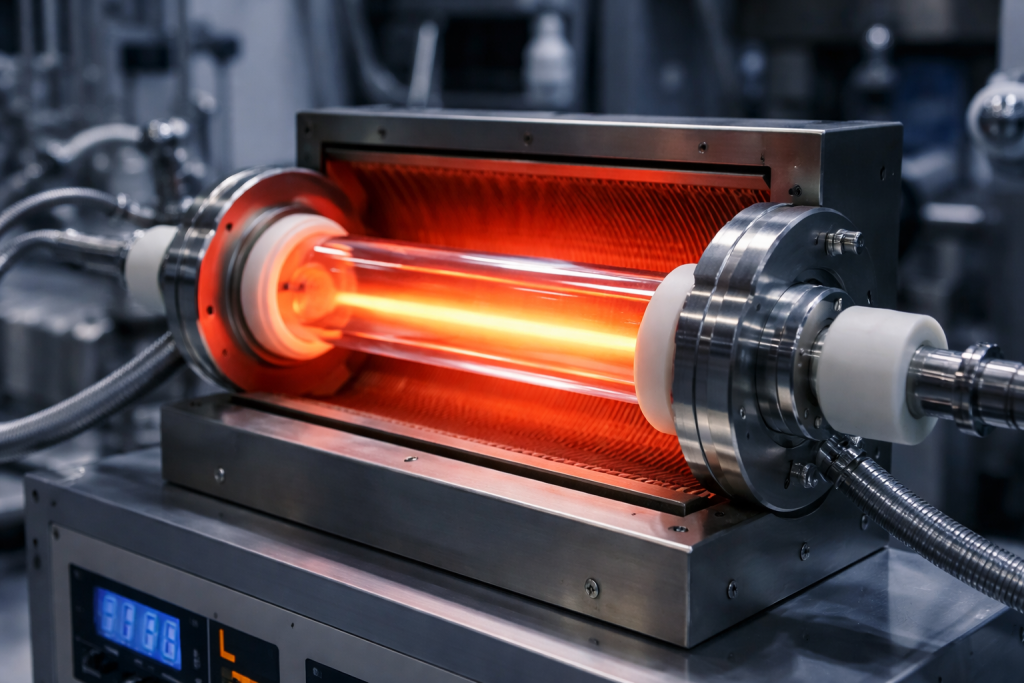
Selecting a quartz crucible by diameter and price alone can lead to contamination, premature cracking or an unexpected reaction with the processed material.
The correct crucible must match the process—not merely the furnace. Purity requirements, bubble distribution, wall design, melt chemistry, operating temperature, holding time and supporting structure all affect service life and product quality.
This guide explains how to specify a fused quartz crucible for laboratory heating, vacuum deposition, photovoltaic manufacturing, semiconductor crystal growth and other high-temperature processes.
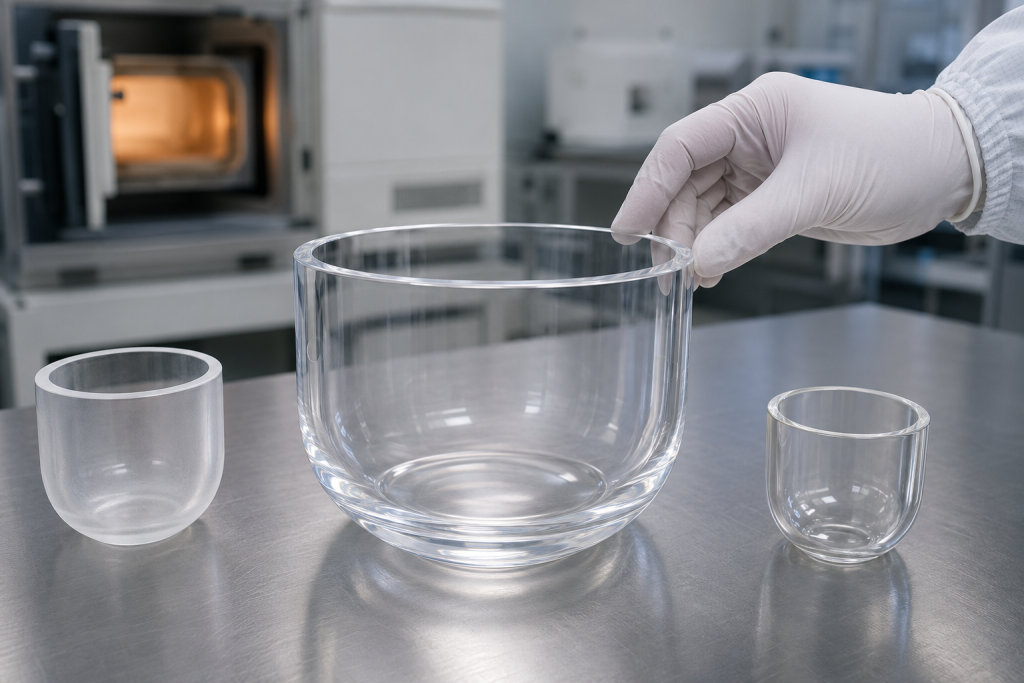
Why Are Fused Quartz Crucibles Used?
Fused quartz combines several useful properties:
- Vysoká chemická čistota
- Nízká tepelná roztažnost
- Good resistance to thermal shock
- High-temperature capability
- Optical transparency in selected grades
- Low electrical conductivity
- Availability in both standard and custom geometries
However, fused quartz is not chemically inert to every molten material. Its low thermal expansion also does not make it immune to cracks caused by contamination, mechanical damage, improper support or extreme temperature gradients.
A reliable selection process should answer four questions:
- What impurities can the process tolerate?
- What bubble population is acceptable near the contact surface?
- What wall distribution is required for the load and thermal cycle?
- Is the processed material chemically compatible with silica?
1. Start With the Application
“Quartz crucible” can refer to very different products.
A small transparent crucible used for laboratory ashing does not require the same construction as a large arc-fused crucible used for Czochralski silicon growth. Likewise, a crucible for short vacuum-evaporation cycles may fail rapidly in a long-duration molten-salt process.
Common applications include:
- Laboratory heating and sample preparation
- Thermal evaporation and vacuum coating
- Melting or holding selected oxides and glasses
- Photovoltaic silicon ingot production
- Semiconductor single-crystal growth
- High-purity chemical processing
- Optical-material research
Before requesting a quotation, provide the supplier with the operating temperature, material being processed, charge weight, atmosphere, holding time and number of expected cycles.
2. Quartz Purity: Look Beyond the SiO₂ Percentage
Purity is one of the most frequently misunderstood specifications.
A statement such as “99.99% SiO₂” provides only a general indication. It does not identify which trace elements make up the remaining impurities. For semiconductor, optical and analytical processes, the identity of those elements may be more important than the total amount.
Trace Elements to Evaluate
Depending on the application, important impurities can include:
- Sodium, potassium and lithium
- Iron, aluminum and titanium
- Calcium and magnesium
- Boron and phosphorus
- Copper and other transition metals
Alkali metals can influence electrical properties and promote crystallization of fused quartz. Iron and transition metals may introduce coloration or process contamination. Boron and phosphorus can be especially important in semiconductor applications because they act as dopants in silicon.
A useful purity specification should therefore include:
- SiO₂ content
- Individual trace-element limits
- Analytical method
- Lot or batch identification
- Certificate of analysis requirements
ICP-MS and ICP-OES are commonly used for trace-element analysis. Hydroxyl content may be evaluated by FTIR when OH concentration affects the application.
Natural and Synthetic Quartz
Natural quartz raw material can provide high purity at a competitive cost when it has been carefully selected and purified. Synthetic fused silica can offer extremely low metallic contamination and better compositional consistency, but at a higher cost.
The correct choice depends on the process:
| Aplikace | Typical selection priority |
|---|---|
| General laboratory heating | Thermal performance and reasonable purity |
| Trace analysis | Low blank contribution for the target elements |
| Optical-material processing | Purity, OH content and optical consistency |
| Photovoltaic silicon | Controlled impurities and stable inner surface |
| Semiconductor silicon | Very low critical-element contamination and complete traceability |
For demanding crystal-growth crucibles, manufacturers may use a high-purity inner layer over a different structural outer layer. Patented crucible designs describe substantially pure, bubble-reduced inner surfaces intended to resist roughening and localized devitrification during silicon processing. See this fused-quartz crucible construction for CZ crystal growth.
3. Bubble Grade Is More Than Visual Transparency
Small bubbles can remain in fused quartz as a result of the raw material and fusion process. Their significance depends on their size, concentration, location and behavior at operating temperature.
A crucible with a visually clear surface is not automatically bubble-free. Conversely, an opaque or bubble-containing outer layer is not necessarily defective.
Why Inner-Surface Bubbles Matter
During long high-temperature cycles, bubbles close to the inner surface may expand. If they open into the process surface, they can cause:
- Surface roughening
- Local particle release
- Increased contact area with the melt
- Entrapment of process material
- Accelerated erosion or devitrification
- Changes in crystal-growth stability
Research on photovoltaic crucibles has examined bubble formation and growth using methods including X-ray tomography and microscopy, demonstrating that bubble behavior is connected to quartz-sand characteristics and crucible processing. See the SINTEF study on fused quartz crucibles.
Inner and Outer Layers May Have Different Requirements
In an engineered crucible, different regions may perform different functions:
- A low-bubble inner layer provides a cleaner contact surface.
- An outer bubble-containing layer may affect thermal radiation and structural behavior.
- The transition between layers must remain stable during heating and cooling.
Processes have been developed specifically to reduce bubbles near the inner surface of semiconductor crucibles while controlling the surrounding structure. One example is described in this patent for quartz crucibles with reduced bubble content.
Therefore, requesting “no bubbles” is usually less useful than defining a measurable bubble specification.
What a Bubble Specification Should Include
Ask the manufacturer to define:
- Maximum permitted bubble diameter
- Bubble count or density
- Inspection area or volume
- Distance from the inner surface
- Required thickness of the bubble-reduced layer
- Treatment of exposed or open bubbles
- Inspection method and acceptance standard
For high-risk applications, a bubble map or representative cross-sectional inspection can be more informative than a general visual grade.
4. Selecting the Correct Wall Thickness
A thicker wall is not automatically better.
Wall thickness must balance mechanical support, thermal response, material cost and process geometry. Excessive thickness can increase heating time and temperature differences through the wall. Insufficient thickness can lead to deformation, rapid erosion or failure under the charge load.
Thin-Wall Crucibles
Potential advantages include:
- Faster thermal response
- Lower crucible mass
- Reduced energy required for heating
- Lower material cost
Possible disadvantages include:
- Smaller erosion allowance
- Greater sensitivity to handling damage
- Reduced stiffness for large charge weights
- Higher risk of distortion if poorly supported
Thick-Wall Crucibles
Potential advantages include:
- Greater mechanical stiffness
- More material available for long-duration erosion
- Better durability in selected large-volume applications
- Additional machining allowance where required
Possible disadvantages include:
- Slower heating and cooling
- Greater thermal gradients during aggressive cycles
- Increased weight and cost
- Higher stress if the wall distribution is uneven
Wall Distribution Is as Important as Nominal Thickness
A crucible may require different thicknesses at the rim, sidewall, transition radius and bottom.
The bottom supports the charge, while the corner transition often experiences a combination of mechanical and thermal stress. Abrupt changes in thickness can create local temperature differences and stress concentrations.
Large crystal-growth crucibles may also require tightly controlled concentricity, bottom geometry and wall uniformity. Layered and multi-region crucible designs have been developed to control wall distribution and the quality of the melt-contact surface, as illustrated by this quartz crucible design for CZ processing.
A proper wall recommendation should be based on:
- Crucible diameter and height
- Maximum charge mass
- Material density
- Maximum temperature
- Heating and cooling rates
- Holding time
- Number of cycles
- Support or susceptor geometry
- Rotation requirements
- Permitted deformation
For custom crucibles, request a wall-thickness map instead of specifying only one nominal value.
5. Material Compatibility: Quartz Is Not Universal
Fused quartz offers good resistance to water, many salt solutions and most acids. However, it is attacked by hydrofluoric acid, phosphoric acid and bases, according to Heraeus’ fused-silica property guidance.
High-temperature compatibility must be assessed separately from room-temperature chemical resistance. A material that appears harmless when cold may react strongly with silica after melting.
General Compatibility Guide
| Process material | Compatibility considerations |
| High-purity silicon | Established application, but dissolution and oxygen transfer must be controlled |
| Many oxide materials | Often possible, but composition and melting temperature must be reviewed |
| Alkali-rich glasses or fluxes | Can accelerate silica attack and devitrification |
| Strong bases and alkali hydroxides | Generally unsuitable for direct quartz contact |
| Hydrofluoric acid or fluoride-reactive systems | Unsuitable because fluorine chemistry attacks silica |
| Phosphoric acid | Can attack fused quartz; verify concentration, temperature and exposure time |
| Molten aluminum | Reactive with silica at elevated temperature; normally requires another crucible material or validated barrier |
| Other reactive molten metals | Must be evaluated individually |
| Vacuum evaporation materials | Compatibility depends on evaporant chemistry, temperature and wetting behavior |
| Unknown mixed compounds | Require a controlled coupon or small-crucible test |
Molten aluminum, for example, can wet and react with fused silica, producing reaction layers and transferring silicon into the metal. This interaction was documented in a Lawrence Berkeley Laboratory study of molten aluminum and fused silica.
Do not assume that all metals, salts or coating materials can be processed safely in quartz simply because the crucible can withstand the required furnace temperature.
When a Coating May Be Considered
Some high-temperature processes use protective or crystallization-control layers to change the interaction between quartz and the melt. Patented approaches for silicon crucibles have used protective layers to reduce reactions, contamination or devitrification at the contact surface. An example is this protective-layer design for quartz crucibles.
A coating should not be treated as a universal solution. It must be evaluated for:
- Adhesion to quartz
- Thermal-expansion compatibility
- Purity and particle generation
- Wetting behavior
- Reaction with the processed material
- Stability over the complete thermal cycle
6. Geometry and Furnace Fit
Even the correct material grade can fail if the geometry does not match the furnace.
Specify the following dimensions:
- Outside and inside diameter
- Overall height
- Usable internal depth
- Rim profile
- Bottom shape
- Corner radius
- Nominal and minimum wall thickness
- Roundness and concentricity
- Flatness where applicable
The crucible should be supported over the intended contact area. Point loading, an oversized support gap or interference during thermal expansion can create cracks.
For rotating crystal-growth systems, geometric accuracy also affects melt stability. Concentricity, balance and the relationship between the crucible and graphite susceptor should be reviewed together.
7. Surface Finish and Cleanliness
The process-contact surface should be selected according to contamination and particle requirements.
Potential specifications include:
- Fire-polished or as-fused surface
- Maximum surface roughness
- Restrictions on scratches, chips and grinding marks
- Čištění kyselinou
- Oplachování vodou vysoké čistoty
- Cleanroom inspection
- Double-bag packaging
- Lot identification on the external package rather than the contact surface
Mechanical polishing can improve dimensions or surface finish, but it may also introduce subsurface damage or contamination if the process is not properly controlled.
For semiconductor and analytical use, packaging and handling can be just as important as the starting purity. A high-purity crucible touched with bare hands or placed on a contaminated bench is no longer a high-cleanliness process component.
8. Inspection and Acceptance Requirements
A purchase specification should define how the crucible will be accepted.
Recommended inspection items include:
- Dimensional report
- Wall-thickness measurements
- Visual inspection under controlled lighting
- Bubble or inclusion grade
- Chip and crack limits
- Surface-condition requirements
- Residual-stress or birefringence inspection where relevant
- Chemical analysis certificate
- OH-content report when required
- Cleaning and packaging confirmation
- Batch and production traceability
Avoid subjective language such as “good quality,” “very pure” or “few bubbles.” Replace it with measurable limits and an agreed inspection method.
9. Signs That a Quartz Crucible Should Be Replaced
Remove a crucible from service when inspection shows:
- A crack extending through the wall
- Growing rim chips
- Significant deformation
- Severe clouding or devitrification
- Inner-surface erosion
- Opened bubbles or cavities
- Flaking or particle generation
- Contamination that cannot be removed safely
- Loss of dimensional fit with the support
A used crucible should not be returned to service merely because it has not yet leaked. High-temperature cracks can propagate rapidly during the next heating cycle.
10. Information to Include in a Quartz Crucible RFQ
To receive a technically useful quotation, provide:
- Drawing or required dimensions
- Process material and chemical composition
- Maximum charge weight
- Operating and peak temperatures
- Heating and cooling rates
- Holding time at temperature
- Furnace atmosphere or vacuum level
- Expected number of cycles
- Crucible support method
- Required purity and restricted elements
- Bubble acceptance criteria
- Surface-finish and cleanliness requirements
- Inspection documents and certificates
- Annual quantity and delivery schedule
If the process chemistry is confidential, provide at least the material family, dominant elements, temperature range and known reactivity concerns.
Často kladené otázky
Is transparent quartz always purer than opaque quartz?
No. Transparency is influenced by bubbles and internal structure, while chemical purity depends on the raw material and production process. A transparent crucible can still contain unacceptable trace elements.
Should I always choose the thickest available crucible?
No. Thickness must match the load, support and thermal cycle. Excessive thickness can increase thermal gradients, while insufficient thickness reduces structural and erosion margins.
Are bubbles acceptable in a quartz crucible?
It depends on their location and size. Bubbles in an engineered outer layer may be acceptable, while large bubbles close to the melt-contact surface can create particle and erosion risks.
Can a quartz crucible be used for molten aluminum?
Direct contact is generally not recommended without a specifically validated barrier system. Molten aluminum can react with silica and contaminate both the crucible and the melt.
Can quartz crucibles withstand rapid heating?
Fused quartz has low thermal expansion and good thermal-shock resistance, but heating rate is still limited by crucible size, wall distribution, surface condition, support and charge geometry.
Can a quartz crucible be reused?
Some laboratory crucibles can be reused after suitable inspection and process-approved cleaning. Semiconductor and high-purity applications may require single-use or tightly controlled reuse policies.
What information is most important for a custom crucible?
The process material, temperature profile, charge weight, holding time, support geometry and contamination limits are more important than the external dimensions alone.
Závěr
Successful quartz crucible selection requires more than choosing a standard size.
Purity must be defined by critical trace elements, not only total SiO₂ content. Bubble requirements should identify size, density and distance from the process surface. Wall thickness must reflect the charge, geometry, support and thermal cycle. Most importantly, the processed material must be chemically compatible with silica at the actual operating temperature.
Providing a complete process specification allows the manufacturer to recommend the appropriate quartz grade, inner-surface quality, wall distribution and inspection standard—and significantly reduces the risk of contamination or premature failure.