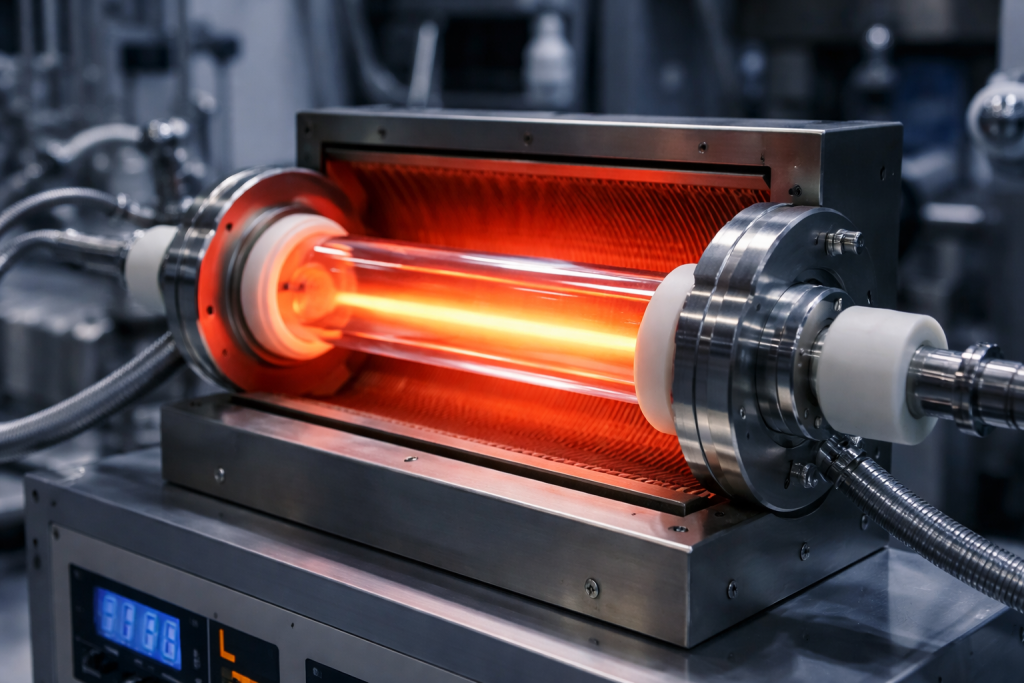
Quartz spiral tubes are special-shaped quartz glass components designed for cooling, condensing, heat exchange, gas flow control, and chemical reaction systems. Compared with straight quartz tubes, spiral tubes provide a longer flow path within a compact space. This makes them useful in laboratory equipment, chemical processing systems, semiconductor-related devices, optical instruments, and high-temperature applications where space, purity, thermal stability, and corrosion resistance are important.
كوارتز مصهور is widely used because it offers excellent thermal shock resistance, high purity, good chemical durability, and stable performance at elevated temperatures. When made into a spiral tube structure, quartz glass can support more efficient heat exchange and more flexible equipment design.
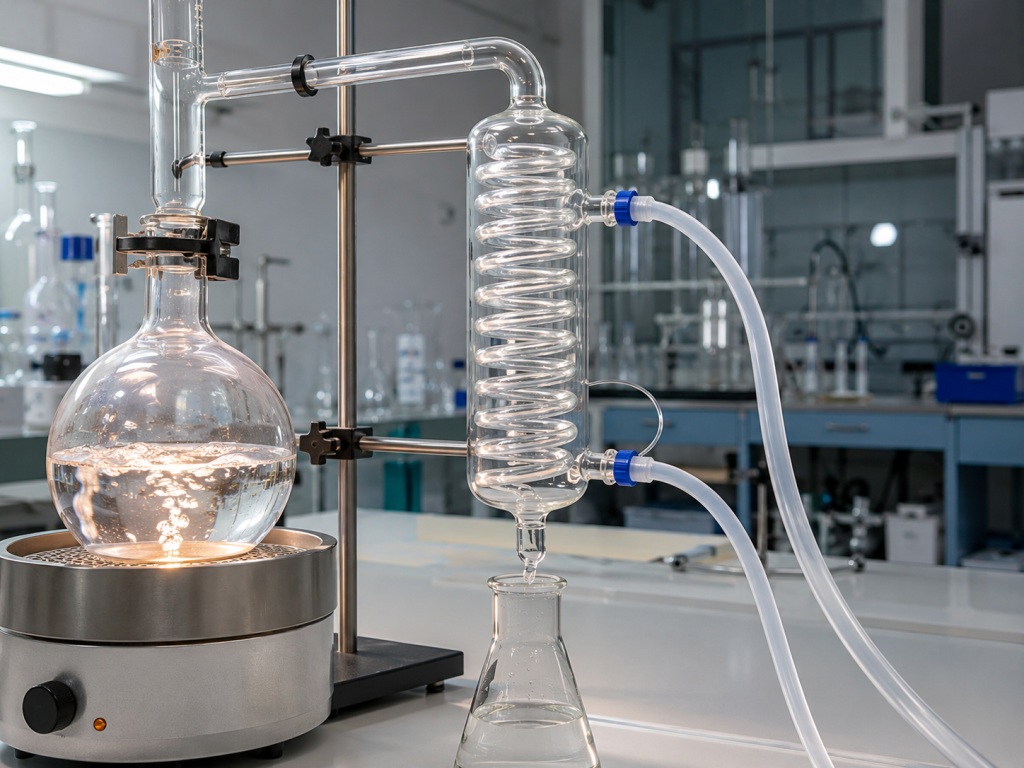
What Is a Quartz Spiral Tube?
A quartz spiral tube is a quartz glass tube formed into a coil or spiral shape. The tube may be made from fused quartz, fused silica, or high-purity quartz glass, depending on the application. It can be designed with different outer diameters, inner diameters, wall thicknesses, coil diameters, number of turns, inlet and outlet directions, and end connection types.
A typical quartz spiral tube may include:
- One continuous quartz tube body
- Spiral or coil-shaped flow path
- Straight inlet and outlet sections
- Optional ground joints or connection ends
- Optional quartz welding or support structures
- Customized diameter and wall thickness
The main function of the spiral structure is to increase the contact area and flow length while keeping the component compact.
Why Use a Spiral Tube Instead of a Straight Tube?
A straight quartz tube is simple and easy to install, but it may not provide enough heat exchange area in a limited space. A quartz spiral tube solves this problem by increasing the effective tube length without requiring a long installation area.
The spiral design can provide several advantages:
| الميزة | Benefit |
|---|---|
| Longer flow path | Improves cooling, condensing, or reaction contact time |
| Compact structure | Saves installation space inside instruments or reactors |
| Larger heat exchange area | Helps improve thermal transfer efficiency |
| Quartz material | Provides high purity and chemical resistance |
| Custom shape | Matches laboratory or industrial equipment design |
| Transparent body | Allows visual observation of flow or condensation |
For systems that need controlled cooling, vapor condensation, gas circulation, or chemical reaction flow, quartz spiral tubes can be more practical than long straight tubes.
Applications in Cooling Systems
Quartz spiral tubes can be used in cooling systems where fluid or gas needs to pass through a controlled path. The spiral shape increases the surface area available for heat transfer, helping the medium cool more efficiently.
Typical cooling applications include:
- Laboratory cooling loops
- Chemical vapor cooling
- Gas cooling systems
- Analytical instrument cooling parts
- High-temperature equipment cooling sections
- Optical or lamp cooling structures
Because fused quartz can withstand rapid temperature changes better than many ordinary glasses, it is suitable for systems where hot gas or vapor must be cooled quickly. However, actual performance depends on tube dimensions, flow rate, cooling medium, temperature difference, and installation design.
Applications in Condensing Systems
Condensing is one of the most common uses for quartz spiral tubes. In a condensation process, vapor passes through the tube or around the tube and loses heat, changing into liquid. The spiral structure helps increase the contact time and heat exchange area, which can improve condensation efficiency.
Quartz spiral condenser tubes may be used in:
- Laboratory condensers
- Distillation systems
- Chemical reaction equipment
- Solvent recovery systems
- High-purity vapor condensation
- Acid-resistant condensation systems
- Special gas or vapor processing
Quartz is especially useful when the vapor or liquid is chemically aggressive, when metal contamination must be avoided, or when high optical clarity is needed for observation.
Applications in Chemical Reaction Systems
Quartz spiral tubes can also be used as reaction channels or process tubes in chemical systems. The long spiral path allows materials to stay in contact for a longer time, which may help with mixing, heating, cooling, or controlled reaction processes.
Common chemical reaction uses include:
- Gas-phase reaction flow paths
- High-purity chemical reaction systems
- Small-volume laboratory reactors
- Acid-resistant process components
- Thermal reaction channels
- Photochemical reaction systems
- Custom quartz reactor assemblies
For photochemical reactions, quartz glass can be useful because it transmits a wide range of light depending on material grade. For high-purity chemical systems, quartz helps reduce contamination compared with some metal or polymer components.
Material Advantages of Fused Quartz
Quartz spiral tubes are often selected because of the material properties of fused quartz or fused silica.
وتشمل المزايا الرئيسية ما يلي:
1. High Thermal Stability
Fused quartz has a low coefficient of thermal expansion, which helps reduce cracking caused by temperature change. This is important in cooling and condensing systems where hot vapor or gas may contact a cooler surface.
2. Good Chemical Resistance
Quartz glass resists many acids and chemical environments. This makes it suitable for laboratory and chemical process systems where ordinary glass, plastic, or metal may not be stable enough.
3. High Purity
High-purity quartz can reduce contamination risk in sensitive systems. This is important for semiconductor, analytical, optical, and high-purity chemical applications.
4. Optical Transparency
Quartz spiral tubes are transparent, allowing operators or engineers to observe flow, bubbles, condensation, color change, or reaction behavior.
5. Custom Processing Flexibility
Quartz tubes can be bent, welded, sealed, connected, ground, polished, and customized into different structures. This allows spiral tubes to be integrated into complex quartz assemblies.
Important Customization Parameters
When ordering quartz spiral tubes, engineers should not only specify “spiral quartz tube.” The supplier needs detailed dimensions and application information.
Important parameters include:
| المعلمة | الوصف |
| Tube outer diameter | Outside size of the quartz tube |
| Tube inner diameter | Flow channel size |
| Wall thickness | Affects strength, heat transfer, and processing difficulty |
| Coil outer diameter | Overall spiral size |
| Coil inner diameter | Inside opening of the spiral |
| Number of turns | Affects total flow path and heat exchange area |
| Pitch | Distance between spiral turns |
| Total height | Space required for installation |
| Inlet and outlet direction | Determines connection and assembly layout |
| End type | Open end, ground joint, flange, welded end, or custom connector |
| تشطيب السطح | As-formed, fire-polished, ground, or polished |
| Cleaning grade | General, laboratory, optical, or high-cleanliness requirement |
A clear drawing is strongly recommended for any custom spiral tube project.
Diameter and Wall Thickness Selection
The tube diameter determines flow capacity, pressure drop, and thermal exchange behavior. A larger inner diameter allows higher flow but may reduce contact efficiency in some compact systems. A smaller inner diameter may improve control but can increase flow resistance or blockage risk.
Wall thickness affects both strength and heat transfer. Thin-wall quartz tubes may provide faster heat exchange but are more fragile. Thick-wall tubes are stronger and easier to handle, but they may reduce heat transfer speed and increase weight.
Selection should consider:
- Flow rate
- Working temperature
- Pressure or vacuum condition
- Chemical medium
- Cleaning method
- Installation stress
- Coil size
- Handling and transportation risk
For aggressive chemical systems or high-temperature systems, the design should be reviewed carefully before production.
End Connection Options
Quartz spiral tubes may need different end structures depending on how they are installed. Common options include:
- Straight open ends
- Fire-polished ends
- Ground glass joints
- Flanged ends
- Bent inlet and outlet sections
- Welded quartz connectors
- Custom adapter ends
- Closed or semi-closed designs
For laboratory systems, ground joints may be useful. For industrial equipment, custom flanges or welded quartz connectors may be required. For compact instruments, inlet and outlet direction is especially important because space may be limited.
Manufacturing Challenges
Quartz spiral tubes are more difficult to manufacture than straight tubes. The bending and forming process requires careful control of heat, shape, stress, and wall uniformity.
Possible manufacturing challenges include:
- Uneven wall thickness after bending
- Deformation at the coil section
- Stress concentration
- Cracking during cooling
- Dimensional variation
- Difficulty controlling tight spiral pitch
- Fragility during packaging and transportation
For this reason, very complex spiral designs should be reviewed with the manufacturer before confirming the final drawing. A prototype may be recommended before mass production.
Quality Inspection Considerations
For custom quartz spiral tubes, inspection should focus on both dimensions and visual quality.
Important inspection items include:
- Outer diameter and inner diameter
- Coil diameter
- Total height
- Number of turns
- Inlet and outlet position
- Wall uniformity
- Surface cracks or chips
- Bubble or inclusion inspection
- End finish quality
- Welding quality if applicable
- Cleanliness and packaging
For high-purity or semiconductor-related applications, additional cleanliness inspection may be needed.
How to Provide a Good Inquiry
A complete inquiry helps the supplier evaluate feasibility, cost, and lead time more accurately. Buyers should provide:
- التطبيق
- Quartz material grade requirement
- Tube OD, ID, and wall thickness
- Coil diameter and total height
- Number of spiral turns
- Inlet and outlet direction
- End connection type
- Operating temperature
- Chemical medium
- Pressure or vacuum condition
- Quantity
- Drawing or sample photo
If the tube is used in a replacement project, sending the old part drawing or sample dimensions can help avoid installation problems.
Common Mistakes to Avoid
When designing or ordering quartz spiral tubes, buyers should avoid the following mistakes:
- Only providing a photo without dimensions
- Not specifying tube ID and wall thickness
- Ignoring inlet and outlet direction
- Designing the coil pitch too tight
- Placing connection points too close to the spiral section
- Not considering cleaning and packaging
- Selecting a wall thickness that is too thin for safe handling
- Ignoring thermal shock and chemical conditions
- Assuming all quartz tubes have the same purity level
- Not confirming whether quartz welding is required
Clear communication at the beginning can reduce rework and production risk.
الخاتمة
Quartz spiral tubes are useful components for cooling, condensing, and chemical reaction systems. Their spiral structure provides a longer flow path and larger heat exchange area in a compact space, while fused quartz material offers high thermal stability, chemical resistance, purity, and transparency.
For laboratory condensers, chemical reactors, cooling loops, vapor systems, and high-purity process equipment, quartz spiral tubes can be customized according to diameter, wall thickness, coil size, number of turns, inlet and outlet direction, end connection, surface finish, and cleaning requirement.
When sourcing custom quartz spiral tubes, buyers should provide a detailed drawing, working temperature, chemical environment, pressure condition, and installation requirements. These details help ensure that the final quartz spiral tube can meet both performance and assembly needs.