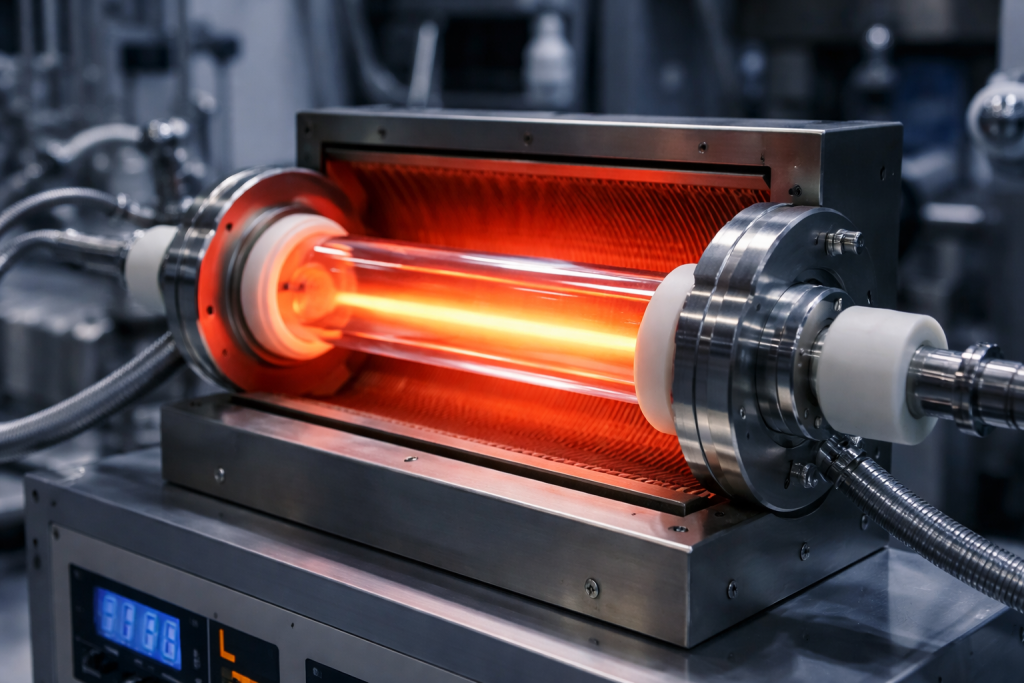
Quartz materials are widely used in semiconductor manufacturing, but not every quartz material is suitable for semiconductor applications.
This is an important point that is often misunderstood. Many customers know that quartz has excellent heat resistance, chemical stability, and optical transparency, so they assume that any quartz material can be used in semiconductor equipment or wafer processing. In reality, semiconductor-grade quartz must meet much stricter requirements than ordinary industrial quartz, laboratory quartz, or general optical quartz.
In semiconductor manufacturing, quartz is not just a structural material. It may come into direct or indirect contact with wafers, process gases, plasma, high temperature, chemicals, or optical systems. Any impurity, particle, bubble, surface defect, dimensional error, or thermal instability may affect process yield and device reliability.
Therefore, the correct question is not simply “Can quartz be used in semiconductors?” The better question is: “Which quartz material is suitable for this specific semiconductor process?”

1. Why Quartz Is Used in Semiconductor Manufacturing
Quartz glass, fused quartz, and fused silica are widely used in semiconductor manufacturing because they combine several important properties:
They offer high purity, excellent thermal resistance, low thermal expansion, good chemical stability, strong electrical insulation, and high optical transmission in selected wavelength ranges. These properties make quartz materials suitable for many process environments where ordinary glass, metals, or plastics cannot perform reliably.
Common semiconductor quartz products include:
Quartz process tubes
قوارب رقائق الكوارتز
Quartz rings
Quartz chambers
Quartz plates
Quartz rods
نوافذ كوارتز
Quartz sleeves
Quartz carriers
Quartz bell jars
حواف الكوارتز
بوتقات الكوارتز
خزانات تنظيف الكوارتز
Quartz optical parts
Quartz components for diffusion, oxidation, CVD, PECVD, etching, annealing, cleaning, and photolithography equipment
However, different applications have very different requirements. A quartz tube for a high-temperature diffusion furnace is not the same as a quartz window for UV exposure. A quartz wafer boat used near wafers is not the same as a general laboratory quartz tube. A quartz crucible for silicon crystal growth has its own purity and thermal stability requirements.
This is why semiconductor quartz material selection must be based on the actual working environment.
2. Not All Quartz Materials Are the Same
In the market, the word “quartz” may refer to several different material categories. These categories are sometimes confused, but they are not identical.
Natural quartz is crystalline SiO₂ found in nature. It can be processed into high-purity quartz raw material, but natural quartz usually contains trace impurities such as aluminum, iron, alkali metals, titanium, calcium, and magnesium. For high-end semiconductor applications, the impurity level must be strictly controlled.
Fused quartz is produced by melting high-purity natural quartz. It has excellent thermal stability and is widely used in semiconductor thermal processing components.
Synthetic fused silica is made from chemical precursors rather than natural quartz crystal. It can offer very high chemical purity and excellent optical performance, especially for UV-related applications.
Quartz glass is a broader term often used for amorphous SiO₂ glass materials, including fused quartz and fused silica.
For semiconductor customers, the material name alone is not enough. It is necessary to confirm purity level, OH content, bubble class, inclusion level, thermal history, optical transmission, dimensional tolerance, surface finish, and cleaning condition.
3. High Purity Is the First Requirement
Purity is one of the most critical requirements for semiconductor quartz.
In semiconductor processes, metallic contamination can affect wafer quality, device performance, oxide growth, junction behavior, leakage current, and long-term reliability. Even very small amounts of sodium, potassium, lithium, iron, copper, aluminum, calcium, magnesium, titanium, or other impurities may become unacceptable in sensitive process environments.
For this reason, semiconductor-grade quartz usually requires strict control of trace elements. In many applications, total metallic impurities must be kept at extremely low levels. Alkali metals such as Li, Na, and K are especially important because they can migrate and contaminate semiconductor devices.
A general industrial quartz product may appear clean and transparent, but it may still contain impurity levels that are too high for semiconductor use. This is why customers should not judge quartz only by appearance.
For semiconductor applications, suppliers should be able to provide chemical analysis data when required, such as ICP-OES, ICP-MS, or other trace-element testing results. The exact impurity limits depend on the process and customer specification.
4. OH Content Must Match the Process Temperature
OH content, also called hydroxyl content, is another important factor in quartz material selection.
OH groups exist in quartz glass as a form of chemically bonded water. They can influence viscosity, infrared absorption, thermal stability, and long-term performance at high temperature.
For high-temperature semiconductor processes such as diffusion, oxidation, annealing, or some CVD applications, low-OH quartz is often preferred. Lower OH content helps improve high-temperature stability and reduces the risk of deformation, sagging, or property change during long-term use.
For lower-temperature optical or wet-process applications, OH content may not be the most critical factor. In some UV optical applications, higher OH synthetic fused silica may even provide better transmission in certain ultraviolet ranges.
This means OH content is not simply “the lower, the better” for every application. It must be selected according to the actual process environment.
For example:
High-temperature furnace tube: low OH content is usually important.
Quartz wafer boat for thermal processing: purity and thermal stability are critical.
UV optical window: optical transmission may be more important than low OH.
Etching chamber component: plasma resistance, purity, and surface condition may be more important.
Cleaning tank or wet-process quartz part: chemical resistance and cleanliness are key factors.
The right quartz material depends on the balance between thermal, optical, chemical, and contamination requirements.
5. Thermal Stability and Low Thermal Expansion
Quartz materials are valued in semiconductor manufacturing because of their excellent thermal properties.
Fused quartz has a very low coefficient of thermal expansion compared with many other materials. This allows quartz components to withstand thermal cycling better than ordinary glass. In furnace, diffusion, oxidation, annealing, and rapid thermal environments, this property helps reduce the risk of cracking, deformation, or dimensional instability.
However, thermal stability is not unlimited. The actual performance depends on material grade, OH content, wall thickness, component geometry, heating rate, cooling rate, stress distribution, and installation method.
A quartz tube or quartz boat may fail if it is heated or cooled too quickly, if it contains hidden stress, or if its design creates local stress concentration. For large or complex quartz parts, proper annealing and stress relief are very important.
Therefore, for semiconductor quartz components, thermal stability should not be evaluated only by the material’s theoretical temperature resistance. It must be considered together with part design, processing method, and real working conditions.
6. Chemical Stability and Process Compatibility
Quartz has excellent chemical stability and is resistant to many acids and process chemicals. This makes it suitable for cleaning, oxidation, diffusion, CVD, and many other semiconductor processes.
However, quartz is not resistant to all chemicals. Hydrofluoric acid and fluorine-containing plasma can attack SiO₂ materials. In etching processes, quartz may be consumed or roughened over time, depending on plasma chemistry and process conditions.
This is why quartz components used in plasma environments require careful material and surface design. The customer may need to consider etch rate, surface roughness, particle generation, lifetime, and replacement cycle.
For wet chemical environments, chemical compatibility must also be confirmed. Even when quartz is chemically resistant, surface cleanliness and contamination control remain critical.
A semiconductor quartz part should not introduce particles, metal ions, organic residue, polishing slurry residue, or packaging contamination into the process.
7. Optical Transmission Requirements
Quartz materials are also used in optical and photolithography-related semiconductor applications because of their excellent optical transmission.
Depending on the material grade, fused quartz and synthetic fused silica can transmit light from ultraviolet to infrared wavelength ranges. This makes them useful for optical windows, UV lamps, exposure systems, inspection equipment, sensors, and laser-related applications.
However, optical quartz requirements are different from thermal-process quartz requirements.
For optical applications, the customer may care about:
Transmission wavelength range
UV transmittance
Internal bubbles
Inclusions
Striae
Birefringence
Surface roughness
التسطيح
التوازي
Wavefront distortion
Coating compatibility
A quartz material that performs well in a furnace may not be suitable for a precision optical window. Similarly, an optical-grade quartz window may not be the best choice for a high-temperature process tube.
This is another reason why application information is essential before recommending quartz materials.
8. Bubbles, Inclusions, and Visual Defects
For semiconductor quartz, internal and surface defects must be strictly controlled.
Bubbles, inclusions, black spots, scratches, chips, pits, cracks, and surface contamination can all affect performance. In optical applications, these defects may reduce transmission or increase scattering. In wafer-processing environments, they may become particle sources or weak points under thermal stress.
Low bubble and low inclusion content are especially important for high-end semiconductor quartz parts. The acceptable defect level depends on the application and inspection standard.
For example, a quartz viewing window may require very low bubbles and high optical clarity. A process tube may focus more on purity, thermal stability, and dimensional accuracy. A wafer carrier may require both high cleanliness and precise geometry.
The supplier should understand which defects are critical for the customer’s process rather than using one generic quality standard for all quartz products.
9. Surface Finish and Cleanliness
Surface quality is one of the most practical requirements in semiconductor quartz manufacturing.
A rough or poorly finished surface can trap contaminants, release particles, or increase the risk of process instability. Scratches, micro-cracks, chips, and grinding marks may become particle sources or crack initiation points during thermal cycling.
For semiconductor quartz parts, the surface may require precision grinding, polishing, fire polishing, chemical cleaning, ultrasonic cleaning, acid cleaning, cleanroom packaging, or other special treatments.
The final cleanliness level should match the application.
For general industrial use, normal cleaning may be enough. But for semiconductor use, customers may require metal-ion control, particle control, clean packaging, double bagging, or special handling procedures.
A quartz component can meet dimensional requirements but still fail semiconductor use if the surface cleanliness is not acceptable.
10. Dimensional Accuracy and Component Design
Semiconductor equipment often requires quartz parts with strict dimensional tolerances.
Quartz process tubes, wafer boats, rings, plates, windows, and chambers must fit precisely into equipment. Poor dimensional control may cause installation problems, gas flow instability, wafer handling errors, thermal stress, or process non-uniformity.
Important dimensional parameters may include:
Outer diameter
Inner diameter
Wall thickness
الطول
التسطيح
التوازي
الاستدارة
التراكز
Slot width
Slot pitch
Wafer spacing
Edge condition
Surface roughness
Assembly tolerance
For wafer boats and carriers, slot accuracy and spacing are especially important. For optical windows, flatness and parallelism may be critical. For process tubes, roundness, wall thickness, and straightness may affect installation and long-term use.
This is why semiconductor quartz manufacturing is not only material selection. It also requires precision forming, machining, welding, polishing, inspection, and cleaning.
11. Electrical Insulation Performance
Quartz is an excellent electrical insulating material. It has high electrical resistivity and good dielectric properties, making it useful in high-temperature and high-voltage semiconductor process environments.
In applications where quartz components are close to plasma, heating elements, electrodes, or sensitive process zones, stable insulation performance helps reduce leakage, contamination, and electrical interference.
However, electrical performance can also be affected by impurities, surface contamination, temperature, and humidity. Therefore, for demanding applications, both material purity and surface cleanliness must be controlled.
12. Matching Quartz Material to Semiconductor Applications
A good quartz material recommendation should begin with customer application questions.
Before selecting material, it is useful to confirm:
What process will the quartz part be used in?
Will it contact the wafer directly?
What is the operating temperature?
Is the process high temperature or low temperature?
Will it contact acid, alkali, HF, or plasma?
Is UV transmission required?
Is optical clarity important?
What are the impurity limits?
Is low OH required?
What dimensional tolerance is needed?
What surface finish is required?
Is cleanroom cleaning and packaging required?
What is the expected lifetime or replacement cycle?
For high-temperature processes, the focus is usually low OH, thermal stability, purity, and deformation resistance.
For optical applications, the focus is transmission, bubbles, inclusions, striae, flatness, and surface quality.
For etching or plasma applications, the focus is purity, particle control, surface condition, and process compatibility.
For wafer handling applications, the focus is dimensional precision, cleanliness, slot accuracy, mechanical stability, and low particle generation.
For cleaning and wet-process applications, the focus is chemical resistance, surface finish, cleanliness, and structural design.
13. Common Quartz Materials Used in Semiconductor Manufacturing
Different quartz material types may be selected according to application:
Electrically fused quartz is often used for high-temperature semiconductor components because of its thermal stability and relatively low OH content.
Flame-fused quartz may be used for general high-purity quartz components, depending on purity and bubble requirements.
Synthetic fused silica is often used for high-purity optical and UV applications where excellent transmission and low metallic contamination are needed.
Opaque quartz may be used in some heat-shielding or thermal applications where transparency is not required.
Natural high-purity quartz raw material may be used as a starting material for fused quartz products or quartz crucibles.
Each material has advantages and limitations. There is no single quartz material that is best for all semiconductor applications.
14. What Standards Should Semiconductor Quartz Materials Meet?
There is no single universal standard that applies to every semiconductor quartz product. Instead, semiconductor quartz requirements are usually defined by a combination of:
Customer drawings
Equipment design requirements
Process environment
Material datasheets
Purity specifications
Inspection criteria
SEMI-related requirements where applicable
Internal fab standards
Supplier quality agreements
In practical purchasing, customers may specify requirements such as:
SiO₂ purity
Trace metal impurity limits
Alkali metal limits
OH content
Bubble and inclusion level
Surface roughness
Dimensional tolerance
Thermal stability
Annealing condition
Cleanliness level
Packaging method
Inspection report
Material certificate
For critical semiconductor applications, the supplier should not only provide the product shape, but also support documentation and traceability.
A “semiconductor-grade” quartz product should be defined by measurable specifications, not only by marketing words.
15. Conclusion: Semiconductor Quartz Must Be Application-Matched
Quartz is one of the most important materials in semiconductor manufacturing, but not all quartz materials are suitable for semiconductor use.
Semiconductor quartz must meet strict requirements for purity, thermal stability, OH content, chemical resistance, optical performance, defect control, dimensional accuracy, surface finish, cleanliness, and traceability.
More importantly, the correct material grade depends on the application.
High-temperature diffusion and oxidation processes need quartz materials with excellent thermal stability and low contamination risk. Optical and photolithography-related applications require high transmission and low optical defects. Etching and plasma environments require careful evaluation of corrosion behavior, particle generation, and lifetime. Wafer handling components require precision geometry and clean surfaces.
For quartz suppliers, the most important step is to understand the customer’s real process environment before recommending a material. For customers, the key is to avoid selecting quartz only by appearance, price, or general description.
In semiconductor manufacturing, quartz is not simply a transparent and heat-resistant material. It is a process-critical material that can influence yield, reliability, and equipment stability.
The right quartz material can support stable semiconductor processing. The wrong quartz material may become a source of contamination, particles, deformation, optical loss, or process failure.