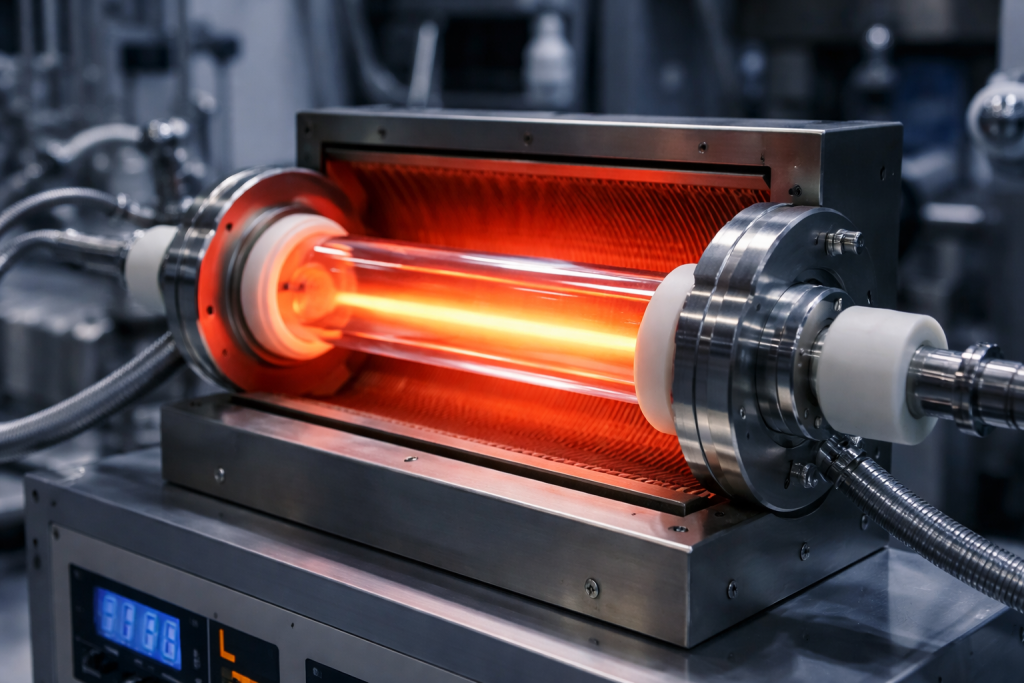
In modern high-tech industries, quartz (primarily high-purity SiO₂) plays a critical role due to its exceptional thermal stability, chemical inertness, and optical transparency. However, standard quartz components often fail to meet the increasingly stringent requirements of semiconductor manufacturing, photonics, and high-temperature processing. This has driven the evolution of industrial quartz customization—a process that integrates materials science, precision engineering, and application-specific design to deliver optimized performance.
1. Material Fundamentals of Industrial Quartz
Quartz used in industrial settings is typically categorized into two types:
- Fused Quartz (熔融石英): Produced by melting natural quartz crystals, offering high purity and excellent optical transmission.
- Fused Silica (合成石英): Manufactured via chemical vapor deposition (CVD) or flame hydrolysis, providing ultra-high purity (≥99.999%) and superior UV transmission.
Key intrinsic properties include:
| الممتلكات | القيمة النموذجية |
|---|---|
| نقطة التليين | ~1665°C |
| Coefficient of Expansion | ~5.5 × 10⁻⁷ /K |
| الإرسال الضوئي | 185–3500 nm |
| مقاومة المواد الكيميائية | Excellent (except HF) |
These properties make quartz indispensable in extreme environments, but also highlight the need for customization when operating conditions deviate from standard assumptions.
2. Why Customization Is Necessary
2.1 Semiconductor Process Demands
In semiconductor fabrication, quartz components such as tubes, boats, and rings must withstand high temperatures (>1000°C), plasma exposure, and aggressive chemicals. Even minor impurities (ppm-level metallic contaminants) can cause wafer defects, making purity control and geometry precision essential.
2.2 Optical and Photonics Requirements
Applications such as UV lithography, laser systems, and spectroscopy require precise control over:
- Surface roughness (often <1 nm Ra)
- Parallelism and flatness (λ/10 level)
- Transmission uniformity across wavelengths
2.3 Mechanical and Thermal Constraints
Customized quartz must be engineered to minimize:
- Thermal stress-induced cracking
- Deformation under prolonged high-temperature exposure
- Microstructural defects (bubbles, inclusions)
3. Core Dimensions of Quartz Customization
3.1 Purity and Chemical Composition Control
High-end applications demand ultra-low levels of metallic impurities (e.g., Fe, Al, Na). Customization may include:
- Selection of synthetic fused silica over natural quartz
- Tailored purification processes (chlorination, plasma refining)
- Batch traceability and contamination control protocols
3.2 Geometric and Structural Design
Quartz components are often custom-designed based on system integration requirements:
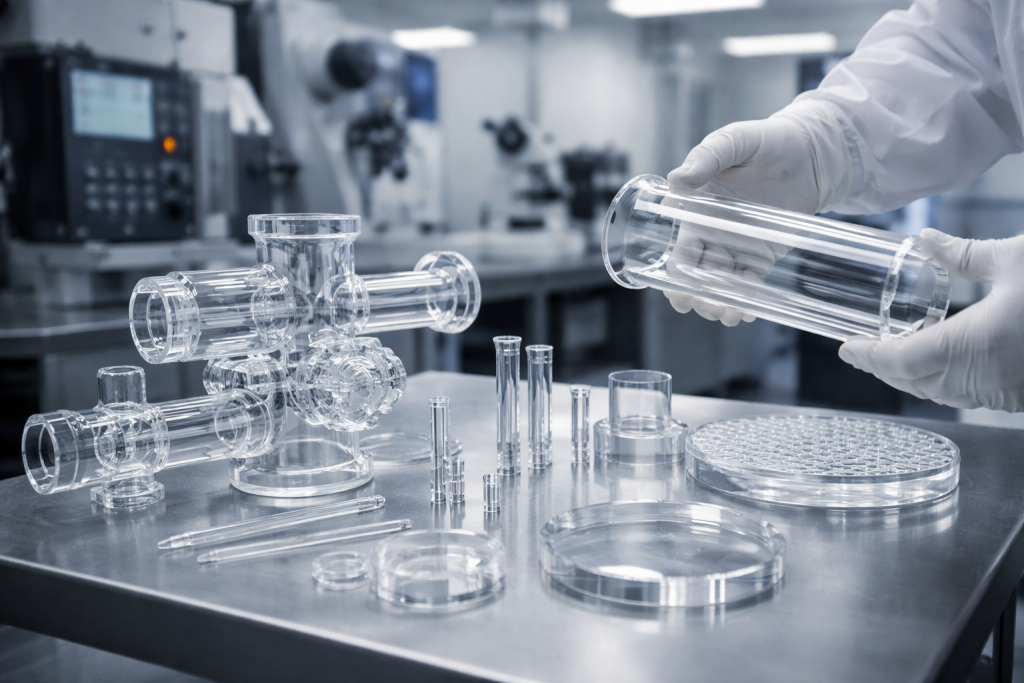
- Complex shapes: tubes, chambers, wafer carriers
- Tight tolerances: ±0.01 mm or better
- Wall thickness optimization to balance strength and thermal response
Finite element analysis (FEA) is frequently used to simulate thermal gradients and stress distribution before fabrication.
3.3 Surface Engineering
Surface quality directly affects both optical performance and contamination risk:
- Polishing: Achieving sub-nanometer roughness
- Fire polishing: Reducing micro-cracks and surface defects
- Coatings: Anti-reflective (AR), hydrophobic, or plasma-resistant layers
3.4 Thermal and Mechanical Optimization
Customization also includes engineering quartz for specific thermal cycles:
- Annealing to relieve internal stress
- Controlled cooling rates to prevent devitrification
- Reinforced designs for rapid thermal processing (RTP)
4. Manufacturing Technologies
The production of customized quartz components involves several advanced techniques:
- التصنيع الآلي باستخدام الحاسب الآلي: For precision shaping
- Laser Cutting and Drilling: For micro-scale features
- Flame Fusion Welding: For joining complex assemblies
- Precision Grinding and Polishing: For optical-grade finishes
Each step must be performed in cleanroom-like environments to prevent contamination.
5. Quality Assurance and Metrology
To meet EEAT (Experience, Expertise, Authoritativeness, Trustworthiness) standards, rigorous testing and validation are essential:
- Spectroscopic Analysis: Verifies purity levels
- Interferometry: Measures surface flatness and optical quality
- Thermal Cycling Tests: Evaluates durability under real conditions
- Dimensional Inspection: Using CMM (Coordinate Measuring Machines)
A typical acceptance workflow includes both in-process inspection and final certification reports.
6. Application Case Studies
6.1 Semiconductor Furnace Tubes
Customized quartz tubes used in diffusion furnaces must maintain dimensional stability at 1100°C while ensuring zero contamination to silicon wafers.
6.2 UV Optical Windows
In deep-UV systems, quartz windows require high transmission at ~193 nm and minimal birefringence, necessitating synthetic fused silica with controlled hydroxyl (OH) content.
6.3 Chemical Processing Equipment
Quartz reactors in corrosive environments benefit from tailored wall thickness and surface treatments to extend service life.
7. Future Trends in Quartz Customization
As industries evolve, several trends are shaping the future:
- Larger-scale components for 300 mm and beyond semiconductor processes
- Integration with advanced coatings for plasma resistance
- AI-driven design optimization for thermal and mechanical performance
- Hybrid materials combining quartz with ceramics or silicon carbide
الخاتمة
Industrial quartz customization represents a convergence of material science and precision engineering. As application environments become more extreme and performance expectations rise, standardized quartz solutions are no longer sufficient. Instead, tailored quartz components—optimized for purity, geometry, surface quality, and thermal behavior—are becoming the foundation of next-generation industrial systems.
For engineers and procurement specialists, understanding the principles behind quartz customization is essential not only for selecting the right material but also for ensuring long-term reliability and process efficiency.